

Chevron Corporation CVX
Regular-session close
Pre-market · Nov 23, 8:56 AM ET
- YTD
- +36.72%
- 1 year
- +38.63%
Discussion (103)
 Another day CVX 5 months ago #1
Take time to read this analysis. It may not be super accurate, but it may be very close.?
Current U.S. commercial crude inventory is approximately 418.2 million barrels, and the Strategic Petroleum Reserve (SPR) holds roughly 340.2 million barrels. Assuming the Strait of Hormuz is fully open and refineries in the Los Angeles port area (PADD 5) run near full capacity, here is the 7-week inventory projection.
7-Week Inventory & Demand Projection
Over the past several weeks, the U.S. has averaged total petroleum product supplied (demand) of roughly 20.6 million barrels per day, equating to about 144.2 million barrels per week.
Starting Inventory: 418.2 million barrels
Weekly Consumption: -144.2 million barrels
Projected 7-Week Demand: 1,009.4 million barrels
Additional Oil Needed (Over 7 Weeks): 591.2 million barrels (Total 7-Week Demand minus 418.2M)
Tanker Logistics & Refinery Throughput
Tanker Transit: A 12,000 nautical mile journey from Saudi Arabia around Africa's Cape of Good Hope at 12 to 15 knots takes about 35 to 45 days (5 to 6.5 weeks).
Port Unloading: A fully loaded Very Large Crude Carrier (VLCC) carrying 2 million barrels takes 24 to 36 hours to safely discharge at the Port of Los Angeles or Long Beach, depending on pumping rates.
Refinery Capacity: The Los Angeles port area and broader West Coast (PADD 5) boast a crude oil distillation throughput capacity of roughly 2.2 to 2.5 million barrels per day.
7-Week Outcome & Strategic Need
At the end of week 7, commercial inventories will be fully drained and require massive drawdowns from the SPR (which currently holds 340.2 million barrels).
State of National Supply: By the end of the 7-week mark, commercial supply would be critically, dangerously low. While the U.S. wouldn't instantly "run dry" of all emergency petroleum, relying completely on the SPR indicates a severe national emergency.
The First Tanker Arrival: If a tanker leaves Saudi Arabia at the beginning of Week 1, it will arrive to unload in Los Angeles at the end of Week 5 to Week 6, meaning there will be a significant operational gap where commercial supplies will need to be bridged by SPR drawdowns and existing domestic production.
Projected Gas & Oil Prices
Because commercial inventories sit 6% below their 5-year average, and the 7-week trajectory requires aggressive use of strategic emergency stocks, the market will register a severe supply-demand deficit. Barring other global market interventions, ,,,,,,, (this desperate running down of stocks will push crude oil and gasoline prices sharply upward as market panic and physical supply constraints drive premiums higher.)
 Money CVX 5 months ago #2
😎🚀🚀🚀🚀🚀🚀🚀
The current price of oil is $89.055 as of 27.05.2026.
Oil reached its all-time high of $147.27 on 11.07.2008. Oil's all-time low of $-40.32 was recorded on 20.04.2020.
Oil represents one of the most liquid assets in global markets, traded in US dollars.
The leading oil exporters are Saudi Arabia, Russia, and the US, which provide a significant share of global supply.
Oil reserves in strategic storage facilities of OECD countries remain an essential factor affecting crude oil price performance.
At the end of February 2026, the United States, together with Israel, launched a military operation against Iran. This led to instability in the energy market, with WTI rising to $113.13. According to various estimates, prices are expected to fluctuate between $92.11 and $146.20. Some analysts expect the asset to trade within the $100–$125 range, with potential growth toward the end of the year.
Forecasts for 2027 vary significantly. Under conservative scenarios, oil is expected to trade within the $99.99–$130.89 range. However, a rise toward $203.75–$369.10 cannot be ruled out.
Projections for 2028–2030 are also mixed. Prices are expected to fluctuate within the $95–$161 range, although some analysts forecast significant growth to $528–$585 by the end of 2030.
Long-term forecasts for 2040–2050 remain highly uncertain. According to some estimates, prices could rise to $522.25–$795.55 by 2040 and to $1,375.54–$1,909.52 by 2050.
The world is running out of oil. Implausible three months ago, the likelihood of a crude shortage on a global scale is becoming increasingly realistic with each day that the Strait of Hormuz remains almost completely blocked. Analysts are no longer modeling for a swift end to the war between the United States, Israel, and Iran. They are now also allowing for an extended period of severe energy flow disruptions—and it is not looking good.
The world is running out of oil. Implausible three months ago, the likelihood of a crude shortage on a global scale is becoming increasingly realistic with each day that the Strait of Hormuz remains almost completely blocked. Analysts are no longer modeling for a swift end to the war between the United States, Israel, and Iran. They are now also allowing for an extended period of severe energy flow disruptions—and it is not looking good.
He said: “What is certain is that the hands of time will not turn backwards and the nations and lands of the region will no longer serve as shields for American bases. The United States not only will no longer have a safe haven for its mischief and for establishing military bases in the region but, day by day, it is growing more distant from its former status.”
He added: “The shaken Zionist regime and the cancerous tumour of Israel are approaching the final stages of their wretched existence.” His remarks put into perspective Trump’s much-derided claim that Arab states, as well as Turkey and Iran, should normalise relations with Israel.
Iran's foreign ministry called the strikes a ceasefire violation and warned that Washington would bear responsibility for “all consequences,” without elaborating.
Money CVX 7 months ago #8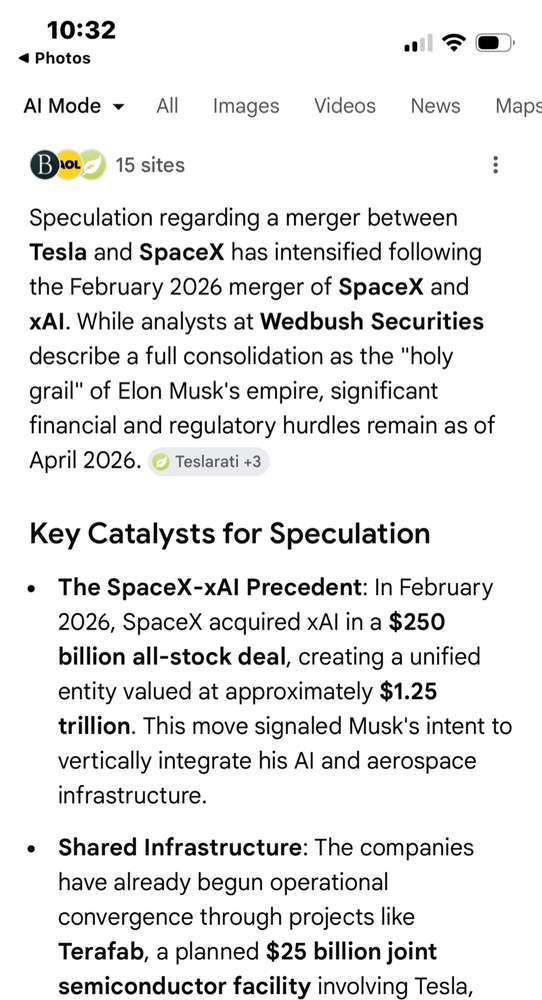
Money CVX 7 months ago #9Time to sell Nadia make it goes down to $130. Let’s cash out to buy space x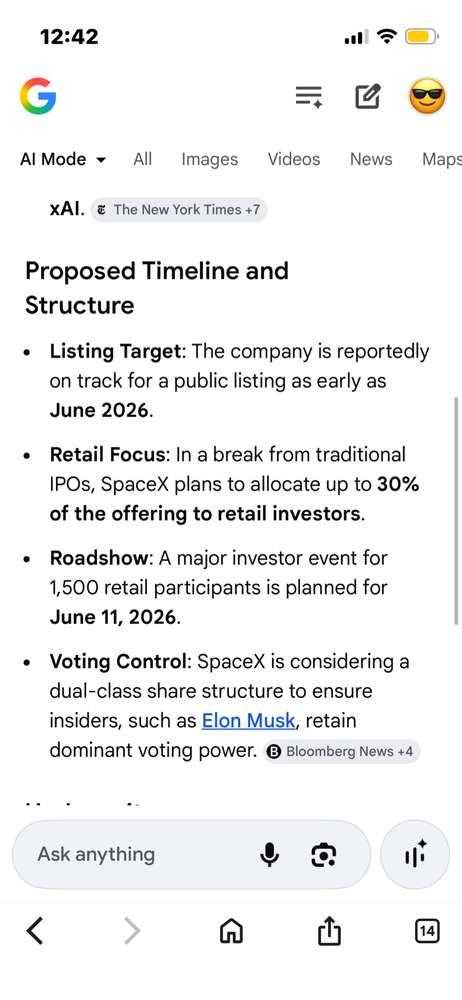
Iran fires more missiles at Israel and rejects Trump's talk as 'fake news' for markets
MARCH 24, 20267:08 AM ET
By
NPR Staff
Israeli security forces take cover during a siren alert while gathering at the site of a Hezbollah missile strike that targeted a bus in the northern Israeli border town of Kiryat Shmona on March 23, 2026.
Israeli security forces take cover during a siren alert while gathering at the site of a Hezbollah missile strike that targeted a bus in the northern Israeli border town of Kiryat Shmona on March 23, 2026.
Jalaa Marey/AFP via Getty Images
Israel and Iran exchanged more missile strikes Tuesday, including one that hit central Tel Aviv, according to Israeli authorities.
The latest exchanges come as Washington and Tehran send conflicting messages about the war's future and possible talks to end it. On Monday, President Trump said the U.S. and Iran have had "productive" conversations about ending the war. He postponed a threatened attack on Iran's energy infrastructure until the end of the week, contingent on talks' progress. Iranian officials, meanwhile, have dismissed the idea of negotiations as "fake news," but Iran's foreign ministry said it was responding to requests through intermediaries of friendly countries.