
BB.TO
BlackBerry Limited
Set alert
- YTD
- +126.83%
- 1 year
- +75.90%
- Open
- 12.28
- Prev close
- 12.85
- Mkt cap
- 6.90B
- Vol
- 5.06M
- Avg vol
- 3.42M
- EPS
- 0.18
- P/E
- 65.28
- Div yield
- 0.00%
More statistics
- Low
- 11.49
- High
- 12.48
- Forward P/E
- 35.50
- Beta
- 1.30
- Short ratio
- 4.51
- Inst. own
- 54.75%
- Dividend
- 0.00
- Ex-div date
- Sep 7, 1999
- 50-d avg
- 11.80
- 200-d avg
- 9.51
- 1y target
- 12.52
Discussion (122)
Sign in to join the discussion
 Elmar A. Busch BB.TO 3 weeks ago #1
Someone sold this morning 1.3 million shares in US, that is reason for the dip!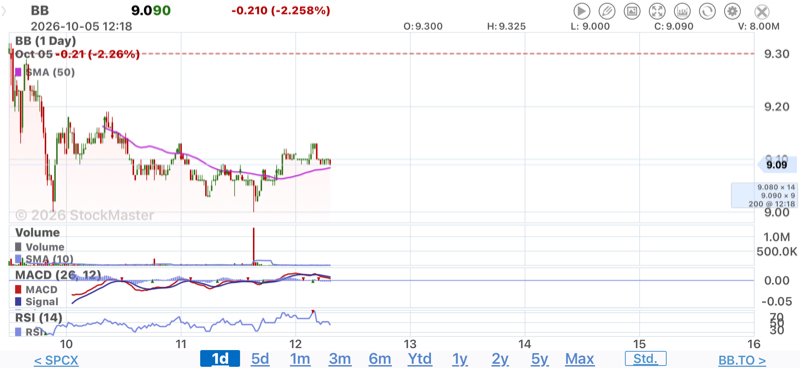
Elmar A. Busch BB.TO 1 month ago #2The consensus anticipates steady execution matching $0.04 EPS / ~$144M Revenue, with development license revenue offsetting auto production volume dips. An outright guidance raise for next quarter is unlikely to be dramatic, given the macro environment across global car manufacturers.
Elmar A. Busch BB.TO 1 month ago #3The catch for BlackBerry investors is that the announcement disclosed no contract value, no revenue split and no timetable for revenue recognition. What Alloy Kore ultimately adds to QNX revenue therefore stays unproven, and the market has to weigh the strategic validation of a marquee truck-maker joint venture against the absence of any dollar figure attached to it.
Elmar A. Busch BB.TO 2 months ago #4Based on the latest information, Fairfax's exit has not caused ongoing damage to BlackBerry. In fact, the company's operational performance and stock price have been showing strength since the exit was completed.
The lack of damage is evident in three key areas:
· Strong Operating Results: BlackBerry's fundamentals have been improving. In June 2026, the company raised its annual revenue forecast, driven by growth in its QNX software division and secure communications business. QNX revenue surged nearly 26% to $72.3 million, and the secure communications division also grew 24%.
· Positive Market Reaction: Following the upbeat forecast, BlackBerry's shares rose about 19% on the Toronto exchange and 20% in the U.S..
· Strategic Progress: BlackBerry is expanding beyond its automotive roots. Its QNX software is now used in industrial automation and medical devices (e.g., a heart pump project with Johnson & Johnson), and it has partnered with NVIDIA for physical AI applications in robotics and factories.
In short, while Fairfax's exit was a symbolic loss for a major long-term backer, BlackBerry's business turnaround appears to be gaining traction, offsetting any potential negative impact from the sale.
Elmar A. Busch BB.TO 4 months ago #5First quarter 2027 earnings released: EPS: US$0.014 (vs US$0.003 in 1Q 2026)
First quarter 2027 results:
EPS: US$0.014 (up from US$0.003 in 1Q 2026).
Revenue: US$152.9m (up 26% from 1Q 2026).
Net income: US$8.50m (up 347% from 1Q 2026).
Profit margin: 5.6% (up from 1.6% in 1Q 2026). The increase in margin was driven by higher revenue.
Revenue is forecast to grow 8.1% p.a. on average during the next 3 years, compared to a 16% growth forecast for the Software industry in Canada.
Over the last 3 years on average, earnings per share has increased by 140% per year but the company’s share price has only increased by 27% per year, which means it is significantly lagging earnings growth.
Elmar A. Busch BB.TO 4 months ago #6
Elmar A. Busch BB.TO 4 months ago #7Make it since 2016 how many times 4.7% down
Since January 1, 2016, the Nasdaq Composite has experienced a daily decline of 4.7% or more during open market hours exactly 8 times.
The vast majority of these concentrated drops occurred during the extreme global liquidity shock of March 2020. However, the exact dates, the macro catalysts, and how long they took to recover reveal how uniquely fast modern market cycles move.
The Complete Timeline (Since 2016)
Here is every single day the Nasdaq broke below a 4.7% regular-session loss, sorted by how long it took to reclaim the pre-crash close.
Date Daily % Return Primary Market Catalyst Trading Days to Fully Recover
March 9, 2020 -7.29% Oil price war + initial COVID-19 lockdown panic 3 Days
May 18, 2022 -4.73% Major retail earnings miss (Target/Walmart) sparks inflation fears 4 Days
May 5, 2022 -4.99% Post-Fed meeting hangover; unwinding of a massive previous-day rally 14 Days
September 3, 2020 -4.96% Sudden tech valuation air pocket after an overextended summer rally 19 Days
September 13, 2022 -5.16% Shockingly hot August CPI inflation print forces jumbo Fed hikes 29 Days
March 12, 2020 -9.43% "Black Thursday" — broad-market liquidity freeze & travel bans 32 Days
March 16, 2020 -12.32% Peak pandemic capitulation; emergency Fed rate cut fails to stop panic 38 Days
April 3, 2025 -5.97% Sharp tech sector margin contraction and high-multiple liquidation 4 Days (Note: Part of a highly volatile back-to-back sequence)
How Long Did It Usually Take to Recover?
Looking at the post-2016 data, the speed of modern market recoveries is incredibly fast compared to previous eras:
The Average Recovery Time: 18 trading days (less than 4 calendar weeks).
The Median Recovery Time: 16.5 trading days.
The Modern Cycle Dynamic
Unlike the multi-year slogs of 2000 or 2008, every single extreme drop since 2016 has been erased in under two months.
Elmar A. Busch BB.TO 5 months ago #8 Elmar A. Busch BB.TO 7 months ago #9The Government of Canada’s expansion of its partnership with BlackBerry (announced March 31, 2026) is a major financial and psychological turning point for the company. While the exact dollar amount of the multi-year deal is often classified for national security reasons, the public filings and market updates reveal four clear financial benefits:
- Revenue Guidance Upgrade
Immediately following the announcement, BlackBerry raised its full-year Fiscal 2026 revenue guidance.
• New Target: The midpoint of total revenue was lifted by $6 million, now ranging between $531M and $541M.
• Secure Communications Segment: This specific division (which includes the Gov-Canada contract) saw its outlook raised to $247M–$251M. This is significant because it indicates the government contract isn't just a renewal of old business, but represents "new" expanded spending. - High-Margin "Sticky" Revenue
The deal focuses on SecuSUITE (encrypted voice/messaging) and BlackBerry UEM (Unified Endpoint Management).
• These are software-as-a-service (SaaS) products, which carry very high gross margins (typically 75-80%).
• Unlike one-time hardware sales, these are multi-year subscriptions. This provides "predictable" cash flow that allows the company to plan its R&D and debt repayments more aggressively. - The "Cylance Gap" is Closing
After BlackBerry sold the Cylance business unit in 2025 (to Arctic Wolf), critics worried the company’s Cybersecurity revenue would collapse. This Canadian government expansion proves that the remaining "Secure Communications" business (the core government/defense business) is strong enough to grow independently. It validates the "New BlackBerry" strategy of focusing only on high-security niche markets. - Validation for Other Five Eyes Nations
Financially, the most important part of this news isn't the Canadian money—it's the validation.
• Canada is part of the "Five Eyes" intelligence alliance (with the US, UK, Australia, and NZ).
• When the Canadian government "significantly increases" its reliance on BlackBerry for "sovereign, mission-critical communications," it serves as a massive sales pitch to the other four nations.
• We have already seen this lead to similar interest from the U.S. Department of Defense and NATO, potentially opening up a pipeline of billions in future government contracts.
What this means for the stock (and Short Sellers)
This news effectively killed the "bankruptcy" thesis. * Cash Flow: BlackBerry reported $17.9 million in operating cash flow in Q3 2026, and this government deal ensures that trend continues.
• Institutional Trust: Major institutions (banks and pension funds) are more likely to buy the stock now that the Canadian government has "vouched" for its long-term viability.
Summary: For BB, this isn't just a "press release." It is a foundational contract that guarantees a baseline of high-margin revenue through the end of the decade, making it a much harder target for short sellers to bet against.
Elmar A. Busch BB.TO 7 months ago #10