

5 Myths And Misunderstandings About Investing In The Stock Market
Sam Ro 6 days ago
MarketsBroad U.S. Equity ETFsEquitiesOpinion
Much of what we know about the stock market comes from a mix of theory and empirical evidence. For example, the idea that earnings drive stock prices is supported by the view that a business’s value is tied to how
Much of what we know about the stock market comes from a mix of theory and empirical evidence.
For example, the idea that earnings drive stock prices is supported by the view that a business’s value is tied to how much money it makes. And decades of market data show that stock prices and earnings have exhibited a tight correlation.
There are also ideas that make intuitive sense, but the evidence supporting them is shoddy. In the stock market, this is a big problem because people will trade on these ideas, only to underperform the market.
Especially when it comes to price behavior, if a theory were both sound and reliable, we’d probably hear more about people consistently beating the market with some bulletproof trading strategy. But we don’t.
With that in mind, here are five ideas about the stock market that I’d describe as myths or misunderstandings.
1. Stock market returns revert to a mean
Periods of strong stock market returns should be followed by periods of weak returns, and vice versa. Right?
If you take a long-term chart of the stock market and add a trendline, you’ll see prices above the line for some time and below it most of the time. This makes it tempting to say that the market exhibits mean reversion, or a tendency to gravitate back toward some historical average.
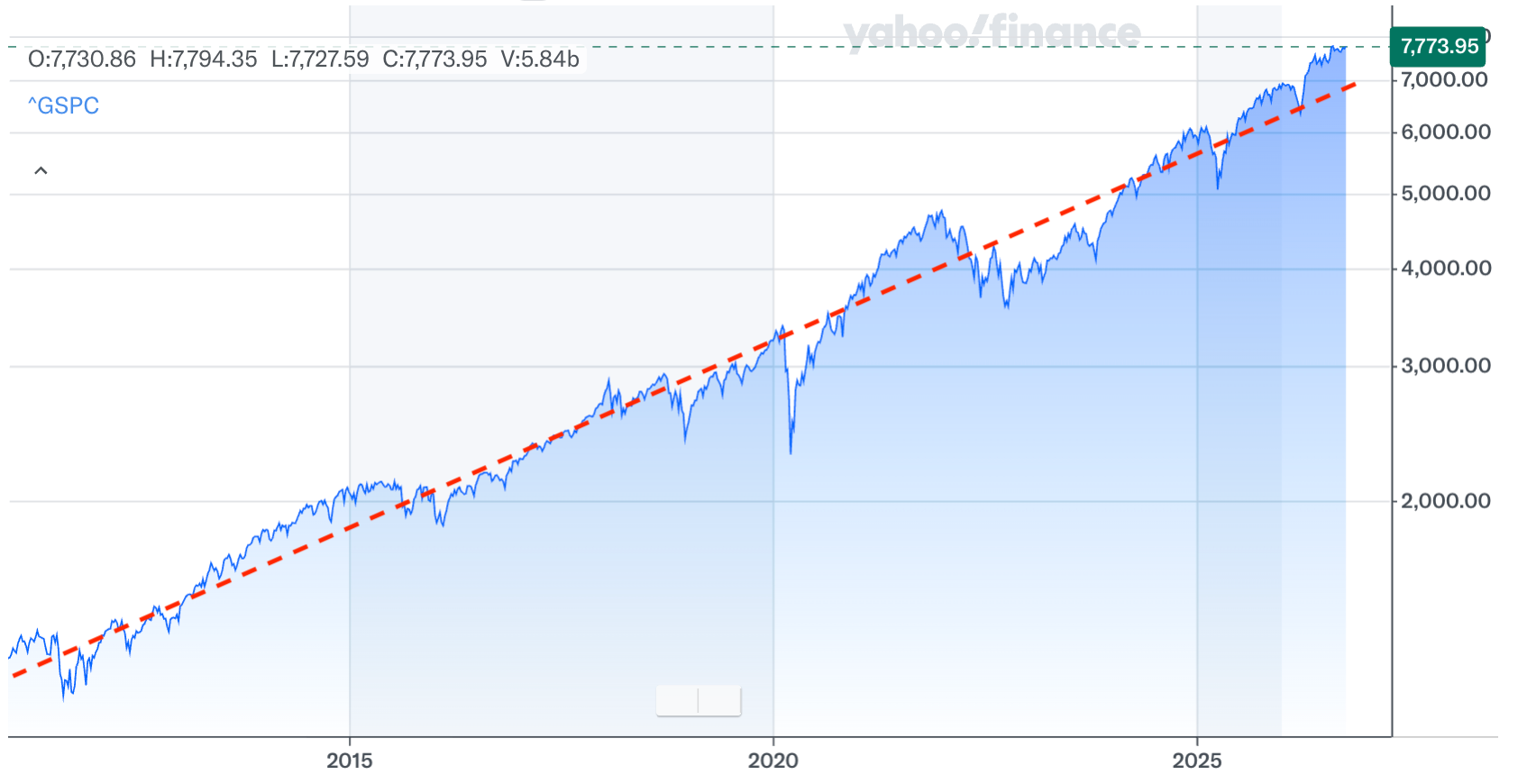
Unfortunately, this behavior is so inconsistent that Professors Paul Marsh, Mike Staunton, and Elroy Dimson concluded that "popular evidence for mean reversion is an ‘optical illusion’ that employs hindsight." They addressed this issue in the 2025 edition of UBS’s "Global Investment Returns Yearbook" and also explored it at length in the 2013 edition, when Credit Suisse published it.
They even went so far as to compare the belief in mean reversion to the Gambler’s Fallacy, the assumption that past outcomes inform future ones.
If mean reversion in the market were consistent and predictable, then there would be a way to trade the phenomenon in such a way as to generate above-average returns. But you don’t really hear about funds or traders consistently beating the market by trading the expectation of mean reversion. (Maybe some secretive hedge fund somewhere has figured it out and they’re not telling us.)
"Market-timing strategies based on mean reversion typically gave lower, not higher, returns," Marsh, Staunton, and Dimson found.
That’s not too surprising when you see the various stats showing periods of strong returns are often followed by more strong returns. Indeed, history shows that investing at all-time highs has produced better returns than investing on all other days.
Keep this in mind the next time someone suggests we’re "due" for weak returns because we just experienced strong returns. What just happened won’t tell you what’s coming next.
2. Valuations revert to a mean
One of the most popular ways to measure value is to divide an asset’s price by its earnings. This is the price-to-earnings (P/E) ratio. When a stock’s P/E is above its historical average, it’s considered expensive. When it’s below average, it’s considered cheap.
This has led many to assume that expensive stocks tend to get cheaper and cheap stocks tend to get more expensive. In other words, valuations tend to revert to a mean, right?
"We cannot emphasize enough that valuation metrics are NOT historically mean-reverting," Goldman Sachs analysts wrote in January. They’ve characterized it as "an oft-repeated myth."
The firm has advanced this controversial view since 2013 (and again in 2022 and 2025). To make their point, they used a Dickey-Fuller test, a tool statisticians use to analyze time-series data. The test found that P/E ratios lacked stationarity, which means the averages aren’t stable over time.
This conclusion aligns with arguments from some top Wall Street strategists in recent years. They’ve argued that persistent improvements in business performance and capital structures have justified the higher valuations we’ve seen lately, an idea supported by theory.
And so, the mean itself is moving.
The idea that valuations aren’t mean-reverting probably makes a lot of people uncomfortable. Then again, trading based on the assumption of mean reversion hasn’t exactly yielded consistent results for people.
3. Picking a market-beating stock is like calling a coin flip
One of the main reasons to buy the stock of a single company is that you believe the price will outperform the market average over some period of time. Otherwise, you’d just put that money into an index fund tracking the market average.
A lot of people try their hand at stock picking. But most fail to beat the market.
Why? Because most stocks lag the market. And it’s far more than half.
In a study published last year, S&P Dow Jones Indices analysts found that just 19% of S&P 500 companies outperformed the average stock’s return from 2001 to 2025. Most S&P stocks underperformed the index in 13 of the past 24 calendar years.
Even with stock correlations very low and dispersion high — conditions that theoretically favor those looking to beat the market — professional stock pickers have struggled to identify winners!
The truth is that market averages, which have trended higher over the years, are driven by a relatively small number of stocks that generate eye-popping returns. ASU Professor Hendrik Bessembinder has published several studies showing this. Even Warren Buffett has attributed Berkshire Hathaway’s outstanding equity portfolio performance to "a few winners."
4. Holding a market-beating stock is a fun experience
Let’s say you got lucky and managed to buy one of these few stocks that go on to smoke the rest of the market. Buckle up.
In a report published last year, Morgan Stanley’s Michael Mauboussin and Dan Callahan studied the price behavior of 6,500 stocks. They took a closer look at the 20 stocks with the best total shareholder returns over the 40 years from 1985 to 2024.
"The median maximum drawdown was 72% for the best group, and the median maximum drawdown duration, the time from peak to trough, was 2.9 years," they found. "The median time to return to the prior peak was 4.3 years."
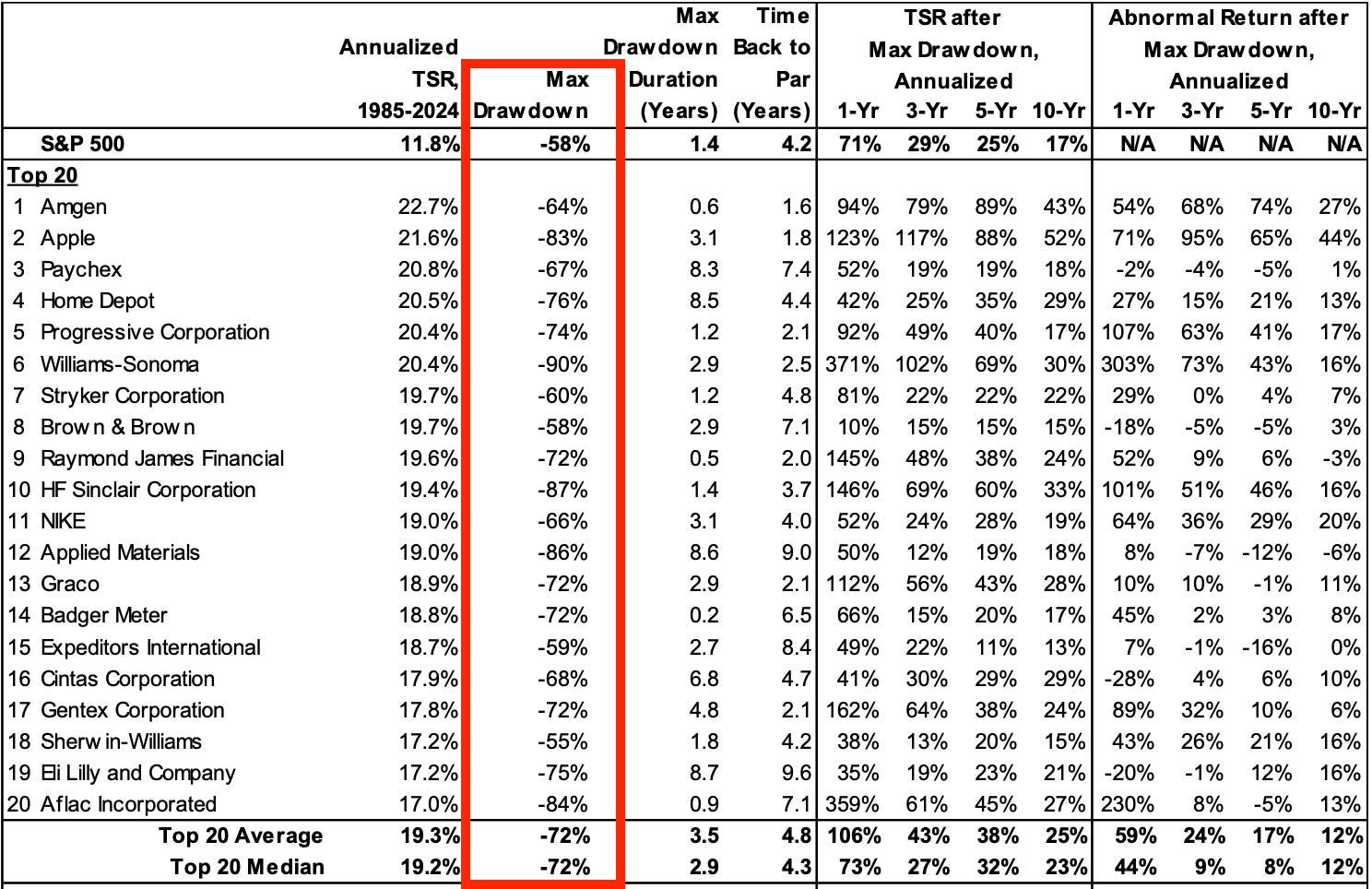
Just thinking about one of my positions losing 72% of its value makes me queasy, even knowing full well this is the average behavior of the best stocks.
If you’re a fund manager with picks like this, you may be fired long before you’ve been proven right.
5. The stock market often delivers average returns
The first thing many of us are taught about the stock market is that the average annual return is about 8% to 10%, give or take a point or two.
That gives many people the impression that the market climbs 8% to 10%-ish somewhat frequently.
But that’s far from the truth.
Carson Group’s Ryan Detrick ran the numbers. Since 1950, the S&P 500 returned 8%-10% in just four years.
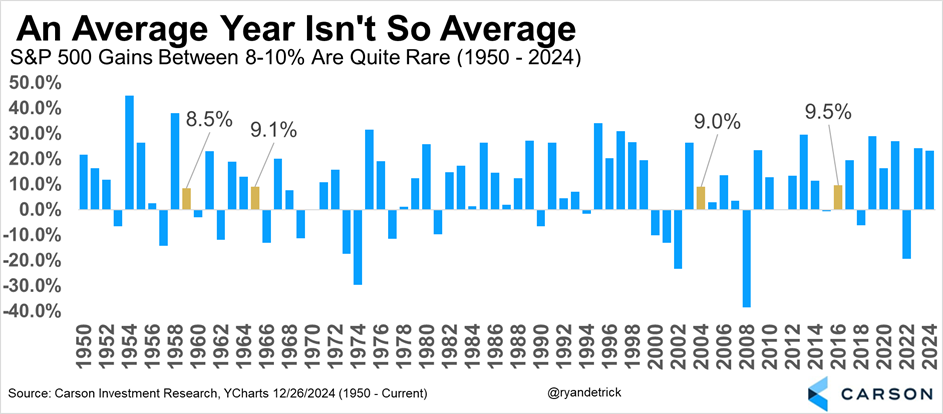
In reality, the long-term average is the result of many above-average years and many below-average years. Ritholtz Wealth Management’s Ben Carlson observed that in the average up-year, the S&P returned 21%. And in the average down-year, the index lost 13%.
This doesn’t mean you should throw these ideas out the window
Maybe you’d be ill-advised to try to beat the market by trading on one of these myths or misunderstandings.
But that doesn’t mean you should ignore them entirely.
Sometimes, weak returns follow strong returns, valuations move toward the mean, half the stocks you pick beat the market, the outperforming stocks you own never lag, and we get an average year in the market.
In other words, sometimes we do get those brief moments when the market behaves as our gut expects.
Just because the markets can be chaotic and unpredictable doesn’t mean they never make sense. It’s just that they don’t make sense on a predictable schedule.
Benzinga Disclaimer: This article is from an unpaid external contributor. It does not represent Benzinga’s reporting and has not been edited for content or accuracy.