


5 Tech Stocks Surging as Wall Street Money Floods East
Benzinga Research Team 9 months ago
OpinionTrading Ideas
Chinese stocks offer potential for growth, but with political tensions. BYD, Alibaba, Tencent are top picks. China's economy and capital markets are supported by government policies.
Investing in China is always fraught with political tensions from the ruling government. Alibaba and Tencent’s woes are just two recent examples. Still, if you have the stomach to deal with that type of risk, you might find Chinese stocks very appealing.
Chinese companies have made several impressive advances in the electric vehicle, AI, and renewable energy industries over the last few years, and the Chinese government continues to signal a commitment to stimulate the economy and capital markets.
Despite this accommodating policy, and their technological successes, Chinese stocks still trade at deep discounts to peers in other countries, and especially to those in the US.
But last year shows this may be changing. Stocks in several countries outside the US grew much faster than here, and investment flows away from the US are only increasing.
So today, we’re looking at five stocks leading the charge in the Chinese equity market, many of which are expanding their international footprint as the U.S. pulls back from international trade.
BYD Co. Ltd.
One of the biggest beneficiaries of the political pushback against Tesla's Elon Musk has been Chinese EV maker BYD Co. (OTCPK:BYDDY), which has become the world’s top electric vehicle seller over the last year. The company now has a $116 billion market cap and delivered more than 2.2 million vehicles in 2025, with earnings of over $108 billion in revenue (in USD). BYD is a vertically integrated company, meaning most components, such as batteries and electronics, are made under the same corporate umbrella. This business model gives BYD a wide moat and the ability to scale quickly to meet demand. With EV adoption rising each year, BYD is well-positioned to become the global leader in battery-powered vehicles.

Despite impressive growth, BYD's stock has struggled to break above the 50-day simple moving average (SMA) since falling into a bear market last year. But the decline appears to be stalling as the stock recently broke above the 50-day SMA resistance level with bullish momentum appearing on both the Moving Average Convergence Divergence (MACD) indicator and the Relative Strength Index (RSI).
2 Stocks Primed to Soar As ‘Round Two’ of the AI Boom Starts
The first surge of AI stocks made early investors rich. Now, ‘Round Two' could be even bigger. But the next wave of winners could look nothing like the last. Discover the two stocks best positioned for this monumental shift. Get Both AI Tickers Here (For Free)
Alibaba Group Holdings Ltd.
Alibaba (NYSE:BABA) is the largest e-commerce company in China, with a market cap of over $400 billion and annual sales of nearly $140 billion as of last year. Jack Ma's infamous dispute with the ruling CCP appears to have subsided (but it’s a good reminder to always consider country risk when investing internationally), and the company's AliCloud business is one of its fastest-growing segments.
A shift toward higher margin services like cloud, logistics, and digital media has boosted the company's outlook, which is why the 18 analysts with BABA coverage tracked by Benzinga label the stock a consensus Buy with an average price target of $173, which is right around where the stock is today. However, the three most recent price targets from Jeffries, Citigroup, and JPMorgan average to $226, implying upside of more than 30%.
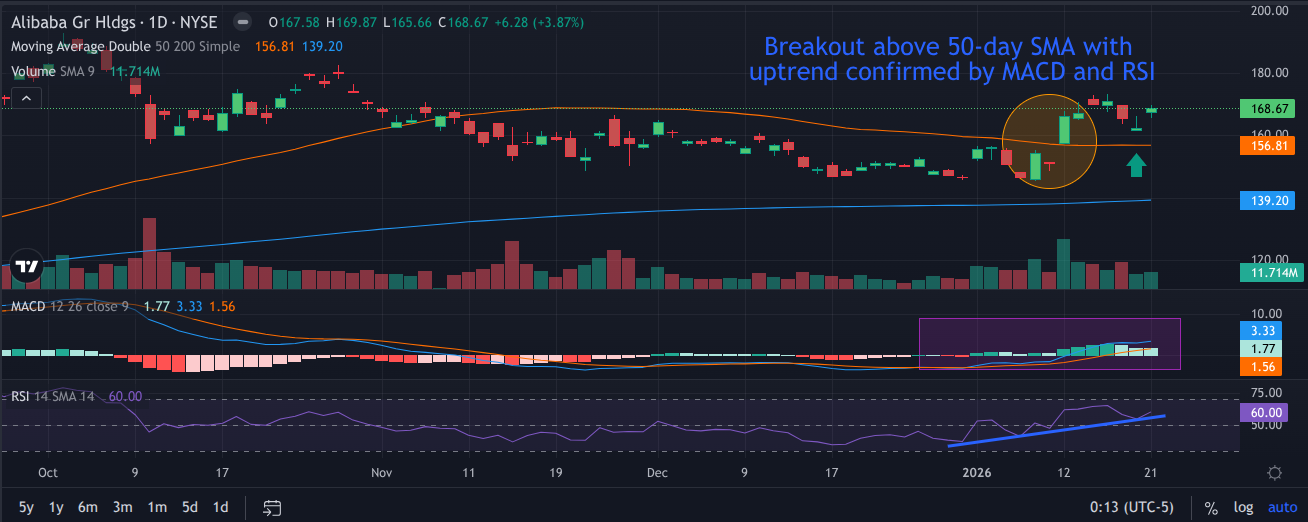
While the long-term has remained bullish, BABA shares spent most of the second half of 2025 battling the 50-day SMA in a rangebound trading pattern. But the bullish MACD cross coincided with a breakout above the 50-day SMA, and the stock is now testing the former resistance level. With the RSI and MACD trending up, the 50-day SMA is likely to switch from resistance to support as bullish momentum accumulates.
Baidu Inc.
The “Google of China” has been on an impressive run, and it may only be getting started. Baidu (NASDAQ:BIDU) is the country's largest search platform, owning more than 70% of the market share for internet searches. Given China's highly restrictive media environment, Baidu's search penetration is unlikely to be undone by competitors anytime soon.
However, the company's ERNIE AI chatbot model has investors thinking about Baidu's next steps as a tech giant. The ERNIE platform and the company's cloud business have shown rapid usage (and revenue) growth, and the stock has already received two price target bumps in 2026 from Jeffries and Freedom Capital Markets, respectively.
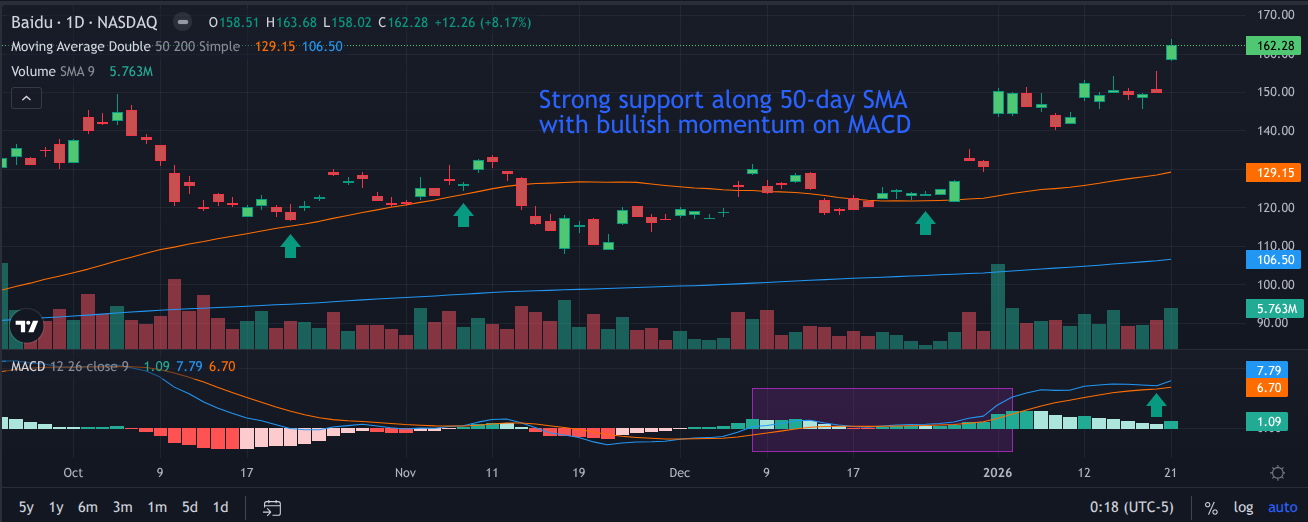
The $55 billion tech giant also trades at just 14 times earnings, and its stock appears poised to enter a new bull market in the new year. BIDU shares had been trading close to the 50-day SMA support level until the MACD lines crossed the histogram in late December, triggering a huge breakout and pushing the share price to levels not seen since late 2021. Baidu's next catalyst is its February 26 earnings report, with analysts expecting $4.36 billion in quarterly revenue.
XPeng Inc.
XPeng (NYSE:XPEV) is a smaller (but still growing) competitor to BYD, with an $18 billion market cap and several models of battery-powered cars and SUVs available. Unlike BYD, XPeng remains in the pre-profit stage of its business, but losses are narrowing, and the company delivered more than 116,000 vehicles in Q3 2025, representing year-over-year (YOY) growth of nearly 150%. The company's next earnings release is scheduled for March 17, and analysts are projecting record revenue of $3.32 billion.

The XPEV chart is choppy, but it is showing signs of a breakout after a long period of consolidation. The share price has been bouncing between the 50-day and 200-day SMAs as the two lines converge. The 200-day SMA dipping under the 50-day SMA would be a bearish signal, but the MACD shows that bullish momentum is starting to grow, and the next sharp move could be to the upside.
VNET Group Inc.
VNet (NASDAQ:VNET) is a data center and cloud infrastructure company with a $2.8 billion market cap at the heart of China's AI boom. VNet directly benefits from AI data center buildouts, as its clients are large cloud and enterprise companies, and its carrier-neutral status allows it to serve multiple providers simultaneously. China's data laws also create strong barriers to entry in this space, and VNet benefits from being a trusted incumbent with a large moat. In its Q3 2025 report, VNet raised full-year revenue guidance after its wholesale revenue surged 82.7% YOY.

VNET shares are attempting their own breakout after finally ripping above the 50-day SMA after several months of bouncing between the 50-day and 200-day marks. The stock appears to be at a crossroads now, however, with the price rechallenging the 50-day SMA while the MACD and signal lines converge. The RSI is trending upward, which offers some optimism for the stock’s direction, but the next few sessions will be crucial for determining VNET's short-term trajectory (the long-term trend remains bullish, though).